

Same Day Hemorrhoid Treatment Benefits
May 21, 2026
Scottsdale Anal Fissure Treatment Options
May 25, 2026
If you are comparing a colorectal doctor vs hemorrhoid specialist, you are probably not doing casual research. You want relief from bleeding, itching, swelling, or pain, and you want to make the right appointment the first time. That distinction matters because while both types of providers may treat anorectal conditions, their focus, treatment style, and care pathway can be very different.
For many patients, the question is not which doctor is more qualified overall. It is which doctor is the best fit for the symptoms you have right now, the treatment you hope to avoid, and how quickly you want to get back to normal life.
Colorectal doctor vs hemorrhoid specialist: what is the difference?
A colorectal doctor, often called a colorectal surgeon, is a physician trained to diagnose and treat a broad range of conditions involving the colon, rectum, and anus. That can include colon cancer, diverticulitis, inflammatory bowel disease, rectal prolapse, fistulas, fissures, and hemorrhoids. Their training is extensive, and their scope is broad.
A hemorrhoid specialist is typically a physician or surgeon whose practice is centered on hemorrhoids and related anorectal issues such as anal fissures. The key difference is focus. Instead of treating many types of colorectal disease, a hemorrhoid specialist concentrates on a narrower set of problems and often builds the patient experience around fast diagnosis and office-based, minimally invasive treatment.
That narrower focus can make a practical difference. If your main issue is hemorrhoid pain, bleeding with bowel movements, anal itching, or tissue swelling, a specialist who treats these symptoms all day may offer a more direct path to relief than a general colorectal practice built around a wider surgical caseload.
When a colorectal doctor makes sense
There are situations where a colorectal doctor is exactly the right choice. If your symptoms may point to something more complex than hemorrhoids, broad colorectal expertise is valuable. That is especially true if there is concern for colon or rectal disease, severe inflammatory conditions, complicated fistulas, or a problem that may ultimately require surgery.
A colorectal doctor may also be appropriate if you have already been evaluated and know your condition is not limited to hemorrhoids. Some patients have overlapping issues, and a broader specialty can be helpful when diagnosis is still uncertain.
This does not mean every hemorrhoid patient needs a hospital-based or surgery-oriented pathway. It simply means that some symptom patterns deserve a wider lens. Heavy rectal bleeding, unexplained weight loss, a significant change in bowel habits, fever, drainage, or severe pain that does not behave like routine hemorrhoids should not be brushed off.
When a hemorrhoid specialist may be the better fit
If your symptoms are strongly consistent with hemorrhoids or an anal fissure, a hemorrhoid specialist may be the more efficient and more comfortable option. This is often true for patients who have tried creams, wipes, dietary changes, or sitz baths and are still dealing with pain, swelling, prolapse, itching, or repeat bleeding.
A focused hemorrhoid practice is usually designed around a simple goal: confirm the diagnosis quickly and treat it without sending the patient down an unnecessary surgical track. That often means office-based procedures, no general anesthesia, minimal downtime, and a care plan built around symptom relief rather than major operative recovery.
For working adults, caregivers, and anyone who has delayed care because of embarrassment, that model matters. A specialist who is used to these exact complaints can often move from consultation to treatment faster and with less disruption to your schedule.
The biggest difference is often treatment philosophy
The most meaningful contrast in a colorectal doctor vs hemorrhoid specialist comparison is not intelligence, credentials, or medical skill. It is often treatment philosophy.
A broad colorectal practice may be equipped to manage everything from cancer surgery to complex anorectal disease. Hemorrhoids are part of that picture, but not the center of it. In some settings, that can mean a more conventional surgical framework or a slower process that involves multiple steps before treatment.
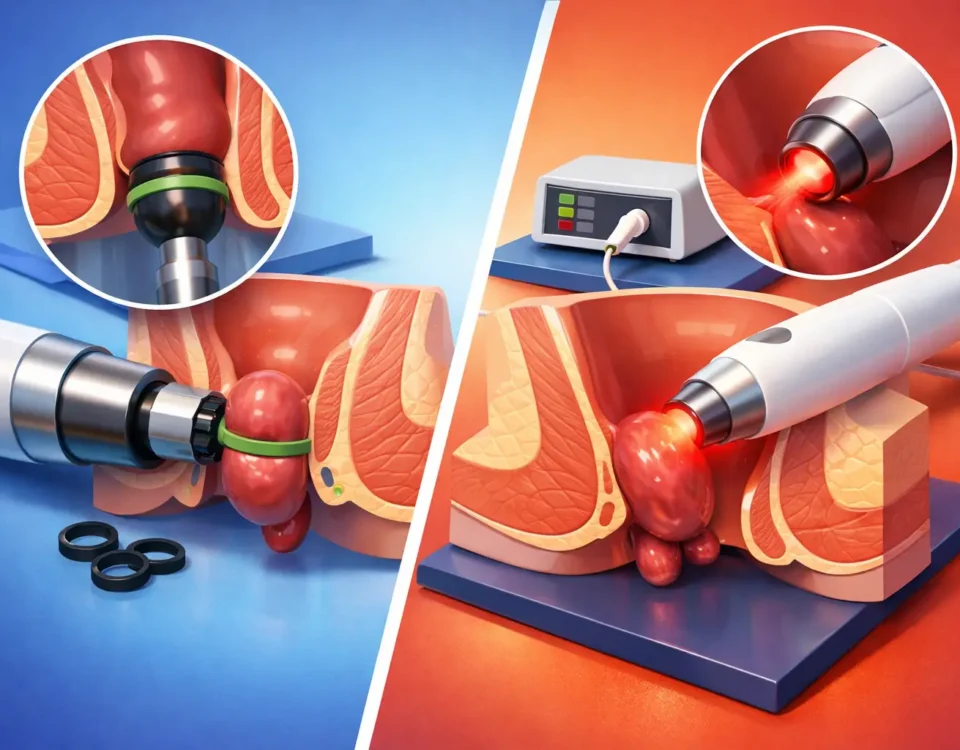
A hemorrhoid specialist, by contrast, often builds the entire care pathway around non-surgical intervention first. If a patient has internal hemorrhoids that are causing bleeding or prolapse, office-based banding may be offered early because it directly addresses the problem without the downtime of traditional surgery. If a fissure is present, the plan may focus on customized medication and healing support before discussing anything invasive.
That difference matters to patients who are not looking for a broad surgical workup. They want the safest effective treatment that gets them out of pain and back to work, family, exercise, and normal daily life quickly.
Diagnosis still comes first
One reason patients hesitate is that they assume a hemorrhoid specialist will automatically label every problem as hemorrhoids. A good specialist does not do that. Focused care still begins with careful diagnosis.
Rectal bleeding, for example, is common with hemorrhoids, but it can also come from fissures, inflammation, polyps, or other gastrointestinal conditions. Anal pain may be caused by an external hemorrhoid, but it can also point to a fissure or another anorectal issue. The right provider should evaluate your symptoms, ask the right questions, examine the area when appropriate, and make sure the treatment plan fits the actual condition.
In a specialized setting, that diagnostic process is often more streamlined because the practice sees high volumes of the same symptom patterns every day. That can reduce delays and help patients get from uncertainty to a clear plan faster.
患者通常最关心的是什么
Most patients are not comparing specialties based on training pathways alone. They are asking more immediate questions. Will this be painful? Will I need surgery? How long will I be out of work? Is this something I can treat in one visit, or will it become a drawn-out process?
That is where a hemorrhoid specialist often stands apart. In many focused clinics, treatment is designed to be done in the office, without general anesthesia, and with little interruption to daily activity. For the right patient, that means care that feels more practical and less intimidating.
This is also why specialty hemorrhoid centers appeal to people who have put off care for months or even years. They are not necessarily avoiding doctors. They are avoiding the idea of a hospital procedure, a painful recovery, or a complicated referral process.
Colorectal doctor vs hemorrhoid specialist: which one should you choose?
It depends on how clear your symptoms are and what kind of care you need.
If you have a known or suspected hemorrhoid problem, especially one that has not improved with home treatment, a hemorrhoid specialist is often the most direct choice. You are more likely to find a practice centered on non-surgical options, symptom relief, and efficient office-based treatment.
If your symptoms are more complex, your diagnosis is unclear, or there are warning signs that suggest a broader colorectal issue, a colorectal doctor may be the right starting point. That broader expertise can be important when the problem may extend beyond hemorrhoids.
There is also some overlap. Some board-certified surgeons treat hemorrhoids within a broader colorectal background while offering specialized non-surgical care pathways. What matters most is not the label alone. It is whether the provider has real experience with hemorrhoid treatment, evaluates symptoms carefully, and offers an approach that fits your condition rather than pushing you toward more intervention than necessary.
A good appointment should leave you with clarity
Whether you choose a colorectal doctor or a hemorrhoid specialist, you should leave the visit knowing what is causing your symptoms, which treatment options are appropriate, and what recovery will realistically look like. You should not feel rushed into surgery if a less invasive option is likely to work. You also should not be reassured too quickly if your symptoms suggest something more serious.
That balance is what good specialty care provides. It is grounded in diagnosis, focused on results, and realistic about what each patient needs.
At Hemorrhoid Centers of America, that focused model is built around fast evaluation and non-surgical treatment for hemorrhoids and fissures, with the goal of relieving symptoms without unnecessary disruption. For many patients, that is exactly the kind of care they were hoping existed but were not sure how to ask for.
If you are deciding where to go, start with the question behind the question. Are you looking for broad colorectal management, or are you looking for expert hemorrhoid treatment that is designed to be efficient, minimally invasive, and centered on getting you comfortable again? For the right symptoms, that answer can make the next step much easier.