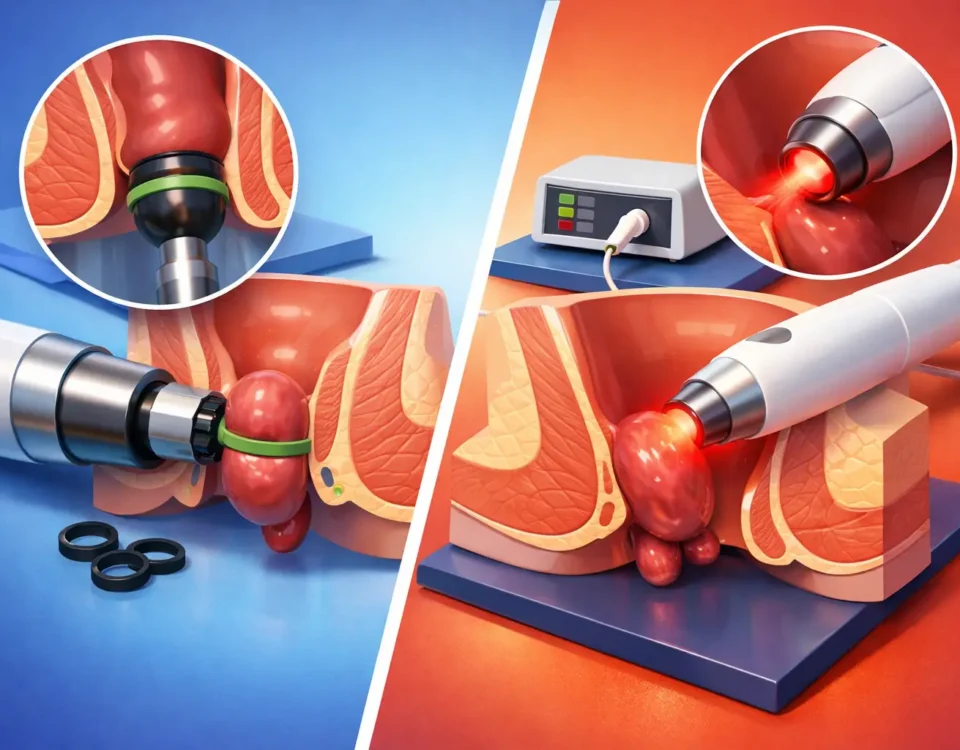


Banding vs Laser Hemorrhoid Treatment Compared
July 18, 2026
Return to Work After Banding: What to Expect
July 22, 2026
Seeing blood on toilet paper, feeling a painful lump, or dealing with itching that will not settle down can make a routine bathroom visit feel like a major disruption. When symptoms persist, the choice between hemorrhoid clinic versus hospital care can affect how quickly you are evaluated, what treatment is offered, and how much time you spend away from daily life.
For many people, the concern is not only relief. It is also privacy, recovery time, and the fear that treatment automatically means surgery. The right setting depends on your symptoms, medical history, and whether there are warning signs that need urgent evaluation. But for common hemorrhoid symptoms and anal fissures, a specialized outpatient clinic can often provide focused, non-surgical care without the hospital experience.
Hemorrhoid clinic versus hospital care: the basic difference
A hospital is designed to treat a wide range of medical needs, from emergencies and complex surgery to serious illness requiring observation. Hospital-based colorectal or surgical care can be appropriate when a patient has severe disease, significant bleeding, complex medical conditions, or a condition that may require an operating room.
A hemorrhoid clinic has a narrower focus. Its providers evaluate and treat hemorrhoids and related anorectal concerns every day. That specialization matters because symptoms such as bleeding, swelling, itching, pain, and tissue protrusion are common, but the right treatment is not always obvious from a home diagnosis.
In a specialty setting, the visit is centered on determining what is causing your symptoms and whether an office-based treatment can help. Rather than beginning with a surgical pathway, the approach may include conservative guidance, custom medication protocols, or minimally invasive procedures such as hemorrhoid banding when clinically appropriate.
Neither option is automatically better for every person. The key question is whether your condition can be safely and effectively managed in an outpatient setting or whether it calls for the broader resources of a hospital.
When a specialty clinic may be the better fit
Many adults wait too long to seek care because they assume hemorrhoid treatment will be embarrassing, painful, or require weeks of recovery. A specialty hemorrhoid clinic is built around a different patient experience: discreet evaluation, focused treatment, and a plan designed to minimize disruption.
Office-based care may be a strong fit if you have symptoms consistent with internal or external hemorrhoids, including rectal bleeding during bowel movements, itching, irritation, swelling, discomfort, or a sensation that tissue is protruding. It may also be appropriate for anal fissure symptoms, such as sharp pain during or after a bowel movement.
The advantage is efficiency without sacrificing clinical judgment. Providers who concentrate on these conditions are familiar with the differences between hemorrhoids, fissures, skin irritation, infections, and other causes of rectal symptoms. They can assess whether a non-surgical option is reasonable before referring you toward more extensive care.
For eligible patients, hemorrhoid banding is commonly performed in the office. The procedure treats certain internal hemorrhoids by placing a small band at the base of the hemorrhoidal tissue. This cuts off blood flow to the targeted tissue so it can shrink and resolve. It does not involve traditional surgery, general anesthesia, or an operating room.
That distinction is meaningful for patients balancing work, family obligations, travel, or caregiving. Many people can return to normal daily activity the same day, although your provider may recommend temporary limits based on your treatment and symptoms.
What hospital-based care can offer
Hospital care has an essential role when symptoms are severe, the diagnosis is uncertain, or treatment may require surgery or close monitoring. A hospital or hospital-affiliated surgical practice may be the right choice for advanced hemorrhoidal disease, complications, or patients with health conditions that raise the risk of an outpatient procedure.
For example, hospital-based care may be considered when a patient needs surgical hemorrhoid removal, has recurrent problems that have not responded to less invasive treatment, or has a complex anorectal condition. Hospitals also have immediate access to anesthesia services, imaging, laboratories, specialists, and inpatient care when those resources are necessary.
This higher level of support can be reassuring when it is medically indicated. At the same time, a hospital pathway can involve more scheduling steps, more preoperative requirements, anesthesia considerations, and a longer recovery if surgery is performed. Those trade-offs are worthwhile when surgery is needed. They are not always necessary for routine hemorrhoid treatment.
Recovery and convenience are real medical considerations
Patients often think convenience is separate from medical care. It is not. If recovery makes treatment difficult to schedule, people may postpone evaluation and continue living with avoidable bleeding, pain, or irritation.
Office-based hemorrhoid treatment is generally designed to reduce that burden. There is no hospital admission and, for appropriate procedures, no general anesthesia. This can mean less preparation and a faster return to work and normal routines than traditional surgical treatment.
Still, minimally invasive does not mean no recovery at all. Some patients experience pressure, mild discomfort, or temporary changes in bowel habits after treatment. Your provider should explain what to expect, how to manage discomfort, and which symptoms require a call after your procedure. Following instructions about hydration, fiber, bowel habits, and activity can help support healing and reduce straining.
Hospital surgery may involve a more substantial recovery period, particularly after a hemorrhoidectomy. Pain control, wound care, time off work, and follow-up are all part of the decision. If a surgeon recommends this route, ask why less invasive options are not suitable in your case and what recovery will realistically look like.
Cost, insurance, and the value of a focused evaluation
Cost is understandably part of the decision, but it is rarely possible to compare care settings with one number. Your out-of-pocket expense can vary based on your insurance plan, deductible, procedure, location, and whether a facility fee or anesthesia charge applies.
A hospital-based procedure can carry costs associated with the facility, operating room, anesthesia, pathology, and postoperative services. An office-based procedure may have a different cost structure because it does not require the same hospital resources. Your actual coverage and financial responsibility should be confirmed directly with the provider and your insurance plan before treatment.
The more immediate value of a specialty evaluation is clarity. Over-the-counter creams, wipes, and home remedies can ease mild symptoms, but they do not confirm the cause of bleeding or resolve every hemorrhoid problem. A focused exam can help you stop guessing and choose a treatment plan that matches the condition.
Do not assume every symptom is a hemorrhoid
Hemorrhoids are common, but rectal bleeding, pain, and changes in bowel habits can have other causes. That is why professional evaluation matters, especially if symptoms are new, persistent, worsening, or occurring alongside unexplained weight loss, fatigue, abdominal pain, or a major change in stool pattern.
Seek urgent medical attention for heavy or ongoing rectal bleeding, black or tar-like stools, fainting, severe weakness, fever, severe pain, or symptoms that make it difficult to pass urine or stool. In those situations, emergency or hospital care may be the safest choice.
A specialty clinic can help distinguish common hemorrhoid and fissure concerns from symptoms that need additional testing or referral. The goal is not to force every patient into one treatment path. It is to identify the safest, most effective next step.
Questions to ask before choosing where to go
Ask whether the provider treats hemorrhoids regularly, what diagnostic exam will be performed, and whether office-based options are available before surgery is considered. You can also ask whether the clinician is board-certified, what recovery is expected, and what symptoms would make a hospital referral necessary.
If you are considering a hospital procedure, ask whether anesthesia is required, whether an outpatient specialty procedure could be appropriate, and how much time you should plan to take away from normal activities. Clear answers can make a sensitive decision feel much more manageable.
At Hemorrhoid Centers of America, care is centered on evaluating hemorrhoids and anal fissures with a focus on non-surgical, office-based treatment when appropriate. That focused approach can give patients a practical path toward relief without assuming that major surgery is the starting point.
You do not have to keep arranging your life around pain, itching, bleeding, or bathroom anxiety. A timely evaluation can replace uncertainty with a clear plan and help you choose care that fits both your symptoms and your life.