

Can Hemorrhoids Cause Narrow Stool?
June 18, 2026
Fissure Medication vs Surgery: What to Know
June 22, 2026
When pain, bleeding, itching, or swelling starts affecting your day, the search for a hemorrhoid doctor near me usually becomes urgent fast. Most people are not casually researching this topic. They want relief, they want answers, and they want to avoid a drawn-out surgical process if there is a better option.
That urgency is reasonable. Hemorrhoids and anal fissures can make work, sleep, exercise, and even simple trips to the bathroom much harder than they should be. The good news is that finding the right specialist is not just about locating the closest office. It is about finding a provider who treats these conditions regularly, can confirm what is actually causing your symptoms, and offers effective care that fits real life.
What a hemorrhoid doctor near me should actually offer
Not every provider who treats hemorrhoids approaches them the same way. Some primary care doctors can help with early symptoms and conservative care. Some general colorectal or surgical practices may evaluate hemorrhoids but lean toward hospital-based procedures or surgery when symptoms become more persistent. A specialized hemorrhoid practice is different because it is built around diagnosing and treating these conditions efficiently, often with office-based, minimally invasive options.
That distinction matters. If you are searching for a hemorrhoid doctor near me, you are probably not looking for a vague consultation and another round of over-the-counter cream recommendations. You are looking for a clear diagnosis, a practical treatment plan, and a path to relief that does not unnecessarily disrupt your schedule.
A strong specialist should be able to evaluate bleeding, pain, irritation, prolapse, swelling, and itching with precision. They should also be able to explain whether you are dealing with internal hemorrhoids, external hemorrhoids, an anal fissure, or a different condition entirely. Those details shape treatment, and guessing can delay improvement.
Why specialization matters more than convenience alone
Choosing the nearest office can feel like the obvious move when symptoms are uncomfortable. But the closest option is not always the most effective one. Hemorrhoids are common, yet treatment quality still varies a lot from one setting to another.
A provider who focuses heavily on hemorrhoids and fissures will usually have a more refined process for evaluation and treatment. That often means less trial and error, fewer unnecessary steps, and a better understanding of when non-surgical care is likely to work well. It can also mean access to office-based hemorrhoid banding and custom medication protocols designed specifically for these conditions.
For many patients, this is the difference between getting temporary symptom management and getting targeted treatment. If you have already adjusted your diet, used topical products, taken warm baths, and still have symptoms, a focused specialist becomes much more valuable.
Signs you should stop waiting and book an appointment
Many people delay care because they hope symptoms will settle down on their own. Sometimes they do. Sometimes they keep returning, get worse, or point to something that should not be self-diagnosed.
You should consider seeing a specialist promptly if you have recurring rectal bleeding, ongoing pain with bowel movements, itching that does not improve, a lump or swelling around the anus, tissue that seems to bulge or prolapse, or symptoms that interfere with daily routines. Bleeding should never be brushed off automatically as hemorrhoids, especially if it is new, frequent, or increasing.
Pain is another important signal. Internal hemorrhoids often cause bleeding and prolapse more than severe pain, while anal fissures can cause sharp pain during and after bowel movements. External hemorrhoids can become acutely painful if a clot forms. Those differences are exactly why a real exam matters.
What to expect at your visit
Fear of the appointment keeps a lot of patients from taking the next step. In reality, the evaluation is usually more straightforward than people imagine.
A hemorrhoid specialist will begin by asking about your symptoms, how long they have been happening, what makes them worse, and whether you have already tried home treatment. The physical exam is focused and designed to identify the source of the problem. In many cases, this can be done quickly in an office setting.
The most important part of the visit is not just naming the problem. It is matching the right treatment to the severity and type of symptoms you have. Mild irritation may respond to medication and bowel habit changes. Persistent internal hemorrhoids may be better treated with banding. A fissure may require a different medication strategy entirely.
That is one reason specialized centers often stand out. They are not trying to fit every patient into the same pathway.
Non-surgical treatment is often the right first step
A lot of patients assume that seeing a specialist means surgery is around the corner. That fear is one of the biggest reasons people put off care. In many cases, it is also unnecessary.
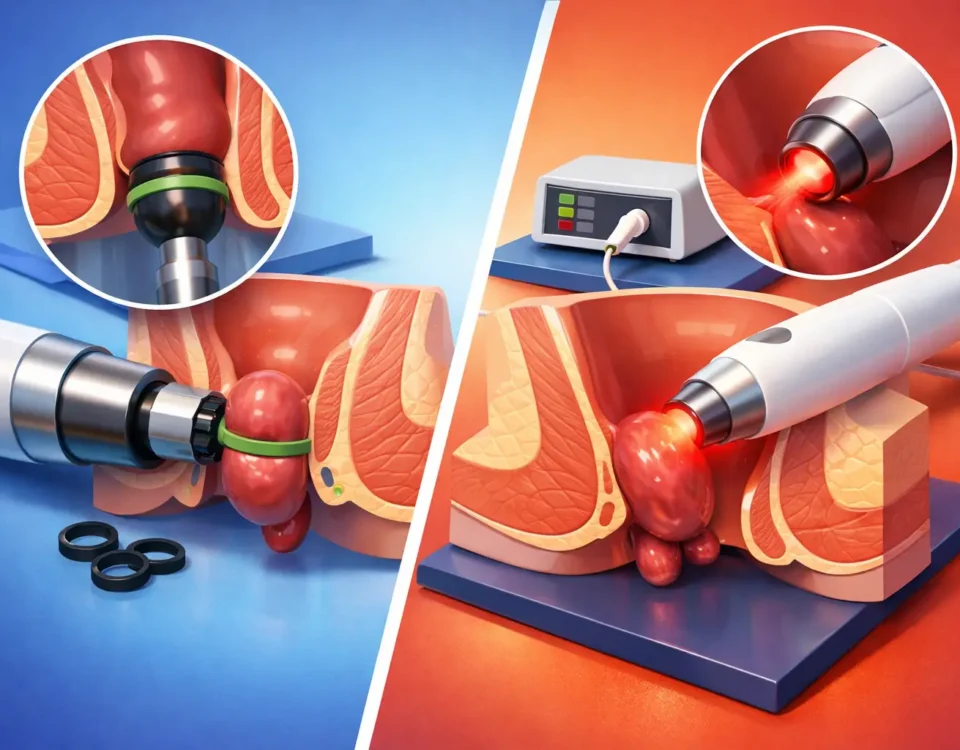
Non-surgical treatment can be highly effective for hemorrhoids, especially internal hemorrhoids that bleed, swell, or prolapse. Office-based hemorrhoid banding is one of the best-known examples. It targets the hemorrhoid directly without the hospital setting, anesthesia, or long recovery associated with traditional surgery.
This approach is especially appealing to patients who want relief but cannot step away from work or family responsibilities for an extended recovery. When treatment is done in the office and downtime is minimal, it becomes much easier to act early rather than waiting for symptoms to become harder to treat.
That said, treatment always depends on the individual case. Large external hemorrhoids, extensive prolapse, mixed disease, or other anorectal conditions may require a different plan. Good specialists are direct about that. They do not promise one solution for every patient. They explain what is most likely to work and why.
How to evaluate a hemorrhoid doctor near me
If you are comparing local options, look beyond distance and appointment availability. Those matter, but they should not be the only factors.
Start with whether the practice has meaningful experience with hemorrhoids and anal fissures specifically. A board-certified surgeon or specialist who treats these problems regularly is usually better positioned to recommend efficient, appropriate care than a generalist who sees them only occasionally.
Next, pay attention to how the practice talks about treatment. Do they emphasize office-based care, minimally invasive options, and fast return to normal activity when appropriate? Or do they stay vague about what happens after the consultation? Patients usually benefit from clarity here.
It also helps to look for a streamlined patient experience. If a clinic is built around this category of care, evaluation and treatment tend to be more efficient. That can mean faster answers and less time spent bouncing between providers.
When convenience and expertise should come together
The ideal answer to a hemorrhoid doctor near me is not simply the closest clinic. It is the nearest qualified specialist who can provide the right level of care without unnecessary escalation.
That combination matters because these symptoms are disruptive, but they are also treatable. Patients often assume they have to choose between living with the problem and going through surgery. In many cases, there is a middle ground – prompt, specialized, non-surgical treatment that addresses the source of the symptoms and lets you return to normal activity quickly.
This is where a focused care model makes a real difference. Practices such as Hemorrhoid Centers of America are designed around exactly that kind of patient need: fast access, expert evaluation, and treatment pathways centered on non-surgical relief.
The biggest mistake patients make
The most common mistake is waiting too long because of embarrassment. Hemorrhoids and fissures are extremely common. Specialists who treat them every day are not surprised by your symptoms, and they are not judging your delay in getting care.
The second mistake is assuming every case is simple. Rectal bleeding, pain, and swelling can overlap across several conditions. Self-diagnosis can lead you toward the wrong treatment, which often means more weeks of discomfort and frustration.
The best time to get evaluated is usually earlier than most people think. Symptoms that seem manageable can become more persistent, and conditions that respond well to office-based treatment are often easier to address before they progress.
If you have been typing the same search into your phone for days, that is usually a sign you are ready for more than home remedies. The right specialist should make the next step feel clear, discreet, and manageable. Relief should not require putting your life on hold.