

Anal Fissure Cream vs Surgery
June 14, 2026
Can Hemorrhoids Cause Narrow Stool?
June 18, 2026
A lot of people wait far too long to get care for rectal bleeding, pain, itching, or swelling. Usually it is not because the symptoms are mild. It is because they are hoping the problem goes away, or they are worried the next step means surgery. That is exactly why many patients start looking for board certified hemorrhoid doctors – they want expert care, a clear diagnosis, and a treatment plan that solves the problem without turning it into a bigger ordeal.
If that sounds familiar, the right specialist can make the process much simpler than you expect. Hemorrhoids and anal fissures are common, but they are not all treated the same way. The doctor you choose affects how quickly you get answers, what treatments are offered, and whether you are pushed toward surgery before less invasive options are considered.
Why board certified hemorrhoid doctors matter
Board certification tells you that a physician has completed advanced training, met specialty standards, and passed rigorous examinations in their field. For patients, that matters because anorectal symptoms can look similar on the surface while coming from different causes. Bleeding, burning, pressure, and itching are not always straightforward. A trained physician needs to determine whether you are dealing with internal hemorrhoids, external hemorrhoids, an anal fissure, or another condition that requires a different approach.
Just as important, a board-certified physician brings judgment, not just credentials. Hemorrhoid treatment is not one-size-fits-all. Some patients need medication and symptom management. Others are better candidates for office-based procedures such as hemorrhoid banding. A smaller group may ultimately need surgical care. The best doctors do not force every patient into the same pathway. They evaluate severity, symptoms, medical history, and lifestyle needs before making a recommendation.
What kind of doctor treats hemorrhoids?
This is where many patients get confused. Primary care doctors and urgent care providers may help with initial symptom relief, but persistent hemorrhoids often need more focused evaluation. In most cases, hemorrhoid treatment is handled by specialists with training in colon and rectal surgery or general surgery, particularly when procedures are involved.
That does not mean every surgeon offers the same type of care. Some practices focus heavily on hospital-based surgical treatment. Others concentrate on non-surgical and minimally invasive options performed in the office. If your goal is to avoid anesthesia, reduce downtime, and get relief quickly, that difference matters.
A specialized practice that treats hemorrhoids every day may be better positioned to diagnose the problem efficiently and offer procedure-based care without sending you through a longer hospital-style process. That focused experience often leads to more practical treatment planning for patients who want results with minimal disruption to work and daily life.
What to look for when comparing board certified hemorrhoid doctors
The first thing to confirm is actual board certification, along with experience treating hemorrhoids and anal fissures specifically. A doctor may be highly qualified in a broad sense, but patients with active symptoms usually benefit from a provider who deals with these conditions routinely rather than occasionally.
The second factor is treatment philosophy. Some doctors move quickly toward excisional surgery. In certain advanced cases, that may be appropriate. But many patients are good candidates for office-based hemorrhoid banding or custom medical treatment that can relieve bleeding, swelling, and irritation without traditional surgery. If you are trying to avoid a hospital procedure, ask what non-surgical options are offered and how often they are used.
The third factor is logistics, which patients sometimes underestimate. When you are dealing with pain or bleeding, convenience is not a luxury. It matters whether the office can see you promptly, whether the evaluation is efficient, and whether treatment can happen without multiple delays. Speed to care can make a real difference when symptoms are interfering with sitting, working, exercising, or simply getting through the day comfortably.
Board certified hemorrhoid doctors and non-surgical treatment
Many people assume that seeing a specialist means surgery is around the corner. In reality, skilled hemorrhoid specialists often help patients avoid surgery entirely.
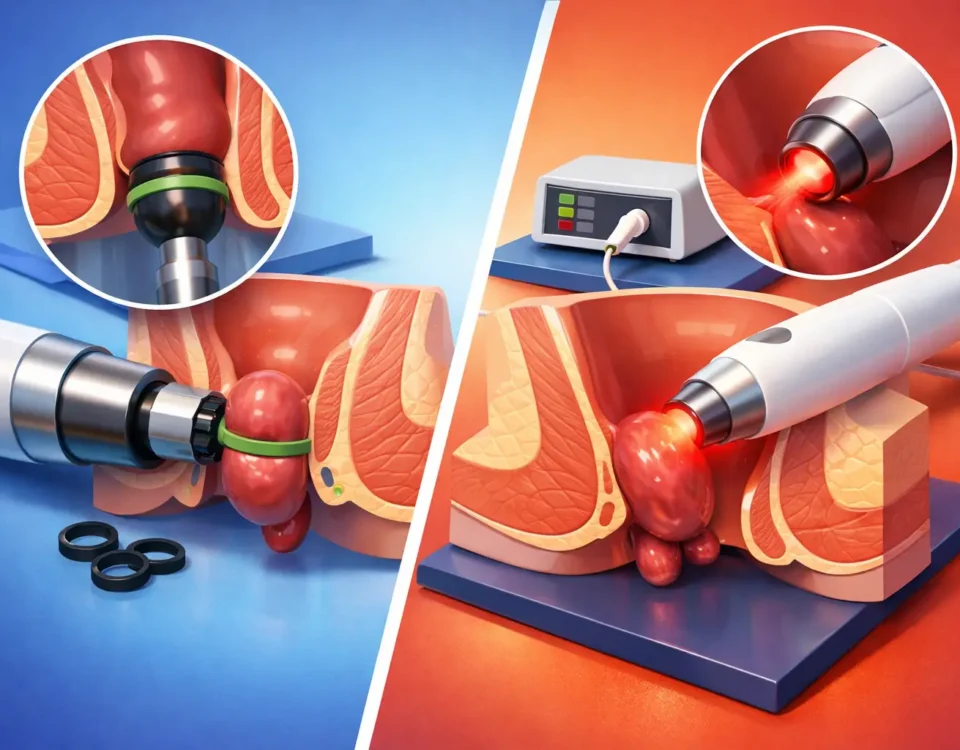
For internal hemorrhoids, rubber band ligation, often called hemorrhoid banding, is one of the most common office-based treatments. It is designed to cut off blood flow to the hemorrhoidal tissue so it shrinks and resolves over time. For the right patient, this can provide effective relief without incisions, anesthesia, or a lengthy recovery.
Anal fissures are different and require a different plan. A fissure is a small tear in the anal lining, and symptoms may include sharp pain, burning, and bleeding. Treatment often starts with medication protocols and measures aimed at reducing sphincter spasm and allowing the tissue to heal. A physician who regularly treats both hemorrhoids and fissures is more likely to distinguish between them accurately and avoid a mismatched treatment plan.
This is one reason focused care matters. Not every practice is built around non-surgical solutions. Some centers, including Hemorrhoid Centers of America, are designed specifically to provide fast evaluation and minimally invasive treatment pathways so patients can get relief without unnecessary surgery whenever possible.
Questions to ask at your appointment
A good consultation should leave you with clarity, not more uncertainty. You should understand what condition you have, how severe it is, what your treatment choices are, and what recovery is likely to look like.
Ask whether your symptoms are coming from hemorrhoids, a fissure, or another condition. Ask whether the doctor recommends conservative treatment, in-office procedures, or surgery, and why. It is also reasonable to ask how long the procedure takes, what discomfort to expect, how quickly you can return to normal activity, and what happens if symptoms come back.
These are not minor questions. They are often the difference between feeling anxious and feeling in control. A strong specialist will answer them directly and explain why one option fits better than another.
Signs you should not keep waiting
Some patients try creams, wipes, sitz baths, and diet changes for months before seeking help. Those measures can be useful for temporary relief, but ongoing symptoms deserve medical evaluation.
If you have recurrent rectal bleeding, persistent pain, swelling that does not improve, a prolapsing hemorrhoid, or symptoms that keep interrupting daily life, it is time to be seen. The same is true if over-the-counter products are no longer helping, or if the symptoms seem to improve briefly and then return.
There is also a safety issue here. Not every case of rectal bleeding is caused by hemorrhoids. A specialist evaluation helps confirm the diagnosis and rule out other causes. Waiting too long can prolong discomfort and delay the right treatment.
What the best care experience should feel like
Patients usually do not want a long medical journey for this kind of problem. They want privacy, fast answers, effective treatment, and a normal routine again as soon as possible. That is a reasonable expectation.
The best hemorrhoid care experience is focused and efficient. You are examined by a qualified specialist. You get a clear explanation of what is happening. If you are a candidate for non-surgical care, that option is discussed plainly. And if a procedure is needed, you understand what it involves and how quickly you can get back to work, errands, exercise, or travel.
That is the practical value of choosing the right doctor from the start. You are not just selecting a name from a directory. You are choosing a specialist who can identify the problem accurately, offer treatment that matches your symptoms, and help you avoid more disruption than necessary.
If you have been putting off care because you are embarrassed, busy, or worried about surgery, those concerns are common. They are also exactly why choosing a board-certified specialist with a non-surgical focus can make the next step feel manageable. Relief usually starts with a proper diagnosis, and the sooner you get one, the sooner everyday life can feel normal again.