

Anal Fissure Treatment Without Surgery
April 9, 2026
Top Treatments for Bleeding Hemorrhoids
April 13, 2026
If you’re searching for how to avoid hemorrhoid surgery, you’re probably dealing with more than inconvenience. Ongoing bleeding, swelling, itching, or pain can wear you down quickly – and for many people, the biggest concern is whether treatment will mean a hospital visit, anesthesia, and a long recovery. The good news is that surgery is not the first or best option for many hemorrhoid cases.
Most hemorrhoids can be treated without traditional surgery, especially when they are diagnosed early and managed by a provider who focuses on non-surgical care. That matters because not every practice takes the same approach. Some patients are told to keep using creams for too long. Others assume surgery is the only next step. In reality, there is a middle ground that often works very well.
How to avoid hemorrhoid surgery starts with the right diagnosis
The first step is making sure hemorrhoids are actually the cause of your symptoms. Rectal bleeding, anal pain, and irritation can also come from anal fissures, skin tags, inflammation, or other conditions that need a different treatment plan. If you treat the wrong problem at home for weeks or months, symptoms can get worse and your options can narrow.
A focused exam from a specialist can usually identify whether you have internal hemorrhoids, external hemorrhoids, or another anorectal condition. That distinction matters. Internal hemorrhoids often respond well to office-based procedures. External hemorrhoids may need a different strategy, especially if there is a painful clot. A personalized diagnosis gives you the best chance of avoiding unnecessary surgery.
Start with conservative treatment, but don’t wait forever
If symptoms are mild or recent, conservative care is often appropriate. That usually means increasing fiber, drinking more water, avoiding straining, and limiting long periods on the toilet. Warm sitz baths can reduce irritation, and some patients get temporary relief from over-the-counter products.
These steps can help, but they also have limits. They may calm a flare without fixing enlarged internal hemorrhoids that continue to bleed or prolapse. This is where people often get stuck. They manage symptoms just enough to get by, then end up in the same cycle again.
A reasonable trial of home care can make sense, especially for mild symptoms. But if bleeding keeps returning, if you feel tissue bulging, or if pain and itching interfere with daily life, it is time to move beyond self-treatment. Waiting too long can turn a treatable problem into one that is harder to control.
Lifestyle changes that actually reduce flare-ups
The goal is to reduce pressure in the rectal veins and make bowel movements easier. That usually starts with 25 to 35 grams of fiber a day, either through food, a supplement, or both. Many patients need more fiber than they realize, and increasing it gradually is often more comfortable than making a sudden jump.
Hydration matters because fiber works best when it absorbs water. Regular movement helps as well. Even a daily walk can support healthier bowel function. If constipation or hard stools are part of the problem, these changes can make a meaningful difference.
Bathroom habits matter too. Straining increases pressure on hemorrhoids, and sitting on the toilet for long stretches often makes symptoms worse. If nothing happens within a few minutes, it is better to get up and try again later.
The non-surgical treatments that often prevent surgery
If symptoms persist despite home care, the next step is not automatically an operation. For many internal hemorrhoids, office-based treatment can relieve symptoms effectively without the disruption of traditional surgery.
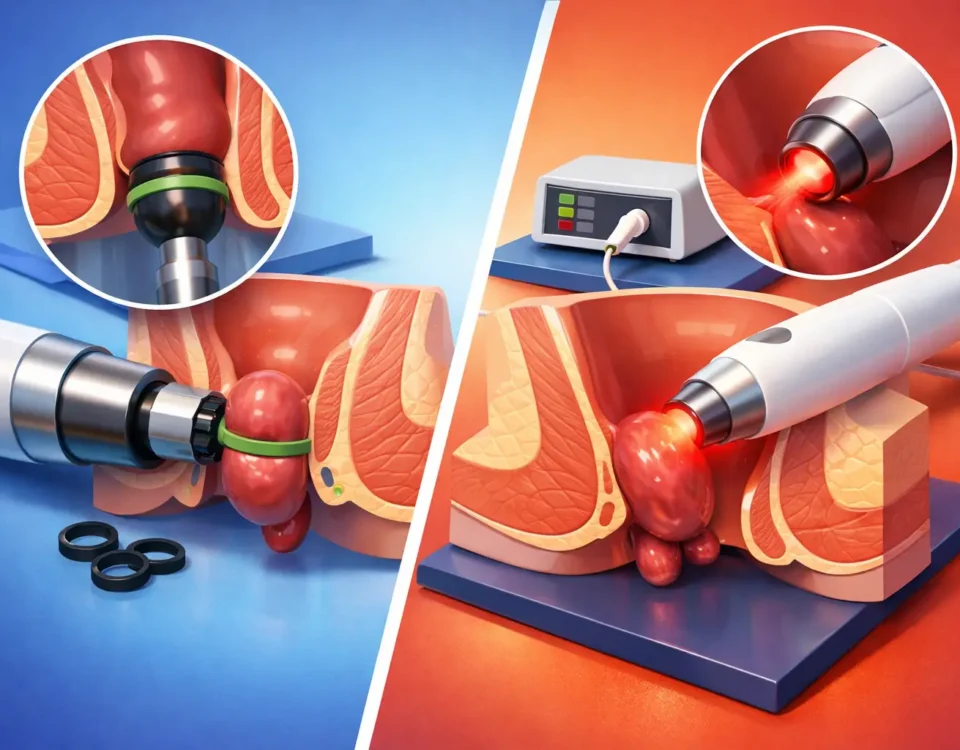
Rubber band ligation, often called hemorrhoid banding, is one of the most common non-surgical options. A small band is placed around the internal hemorrhoid, cutting off its blood supply. The tissue shrinks and falls away over time. The procedure is typically done in the office, does not require general anesthesia, and usually allows patients to return to normal activity quickly.
This approach is especially useful for internal hemorrhoids that bleed, protrude, or recur despite conservative treatment. It is not the right fit for every case, but for the right patient, it can be the treatment that stops the cycle before surgery is ever needed.
Some patients also benefit from prescription treatment plans designed to reduce inflammation, calm irritation, and support healing. That can be particularly helpful when symptoms overlap with an anal fissure or when irritation is making recovery harder.
Why timing matters
One of the best ways to avoid hemorrhoid surgery is to treat the problem before it becomes severe. Hemorrhoids tend to progress when they are ignored. What starts as occasional bleeding can become more frequent prolapse, more swelling, and more discomfort.
Early intervention often means more choices. Smaller internal hemorrhoids are usually easier to treat with non-surgical methods than advanced disease that has been flaring for years. That does not mean every long-standing hemorrhoid requires surgery, but the path can become more complicated when care is delayed.
When surgery is less likely – and when it may still be needed
Many patients are good candidates for non-surgical care. In general, surgery is less likely when symptoms come from internal hemorrhoids, when there is no major external component, and when treatment starts before the condition becomes advanced. Patients who mainly have bleeding, irritation, or mild prolapse often do well with office-based treatment.
There are cases where surgery may still be appropriate. Large external hemorrhoids, mixed internal and external disease, severe prolapse, recurrent thrombosis, or symptoms that do not respond to less invasive treatment can change the equation. The right goal is not avoiding surgery at all costs. It is avoiding surgery when an effective non-surgical option is available.
That distinction matters. A good specialist should be honest about whether a non-surgical approach is likely to work for your specific case, not just in general.
How to avoid hemorrhoid surgery without wasting time on temporary fixes
Patients often come in after trying every cream, wipe, and home remedy they could find. Some of those products can soothe the area for a short time, but they rarely solve persistent internal hemorrhoids. If you have repeated bleeding, tissue that comes out during bowel movements, or symptoms that keep coming back after brief improvement, temporary relief is not the same as treatment.
A more effective plan usually combines symptom control with a procedure or targeted therapy that addresses the source of the problem. That is where specialized care can make a difference. Practices that focus on hemorrhoid treatment are often better positioned to offer office-based options quickly and help patients avoid the hospital-style pathway many people want to avoid.
At Hemorrhoid Centers of America, that focus is on non-surgical treatment designed to relieve symptoms efficiently and get patients back to normal life with minimal downtime.
Signs you should see a specialist now
If you have rectal bleeding more than once, pain that is not improving, a lump that feels swollen or tender, itching that keeps returning, or tissue that protrudes during bowel movements, it is time to be evaluated. The same is true if you have already made diet and hydration changes and symptoms still persist.
This is especially important for adults who have delayed care because of embarrassment or because they assumed the problem would go away on its own. Hemorrhoids are common, and specialists treat them every day. The sooner you get a clear answer, the more likely you are to have simple, effective treatment options.
For patients in places like Atlanta, Scottsdale, Oak Brook, or Post Falls, access to office-based hemorrhoid care may mean you can be evaluated and treated without the disruption of a hospital setting. That convenience is not just about scheduling. It can be the reason people seek care sooner, which improves the odds of avoiding surgery.
What patients often get wrong about hemorrhoid treatment
A common misconception is that if home remedies do not work, surgery is the only next step. Another is that bleeding should be tolerated as long as it is not severe. Both assumptions lead people to wait longer than they should.
The better mindset is this: persistent hemorrhoid symptoms deserve a real diagnosis and a treatment plan matched to severity. Sometimes lifestyle changes are enough. Sometimes office-based treatment is the right move. Sometimes surgery is necessary. But many patients have more options than they realize.
If you are trying to figure out how to avoid hemorrhoid surgery, the best move is not guessing. It is getting evaluated early, treating the right condition, and choosing the least invasive option that is actually likely to work. Relief is often faster, simpler, and more manageable than people expect.