

Oak Brook Hemorrhoid Treatment Options
July 4, 2026
Guide to Internal Hemorrhoid Grades
July 8, 2026
Bleeding after a bowel movement, constant itching, or a painful swollen lump can turn an ordinary workday into something you plan your schedule around. When home remedies stop helping, many patients start looking for the best office procedures for hemorrhoids because they want real relief without surgery, anesthesia, or days away from normal life.
That is a reasonable goal. Many hemorrhoids can be treated effectively in an office setting, often in a short visit, with minimal disruption afterward. The right procedure depends on the type of hemorrhoid, the severity of symptoms, and whether the real problem is hemorrhoids at all.
What makes the best office procedures for hemorrhoids?
For most patients, the best option is not the most aggressive treatment. It is the one that matches the hemorrhoid being treated, relieves symptoms quickly, and avoids unnecessary recovery time. Office-based care is designed around that idea.
The main advantage of office procedures is that they are minimally invasive. They usually do not require general anesthesia, hospital admission, or the longer recovery associated with traditional hemorrhoid surgery. For patients dealing with pain, bleeding, itching, or prolapse, that difference matters.
A good office procedure should also be precise. Internal hemorrhoids and external hemorrhoids do not behave the same way, and they are not treated the same way. Some procedures are especially effective for internal hemorrhoids that bleed or prolapse. Others may do very little for external swelling, skin tags, or symptoms caused by an anal fissure.
That is why an expert exam matters before treatment begins. Rectal bleeding, irritation, and pain can overlap across several conditions, and choosing the wrong treatment path delays relief.
Rubber band ligation is often the leading office procedure
When people ask about the best office procedures for hemorrhoids, rubber band ligation is often at the top of the conversation for a reason. It is one of the most established and effective non-surgical treatments for internal hemorrhoids.
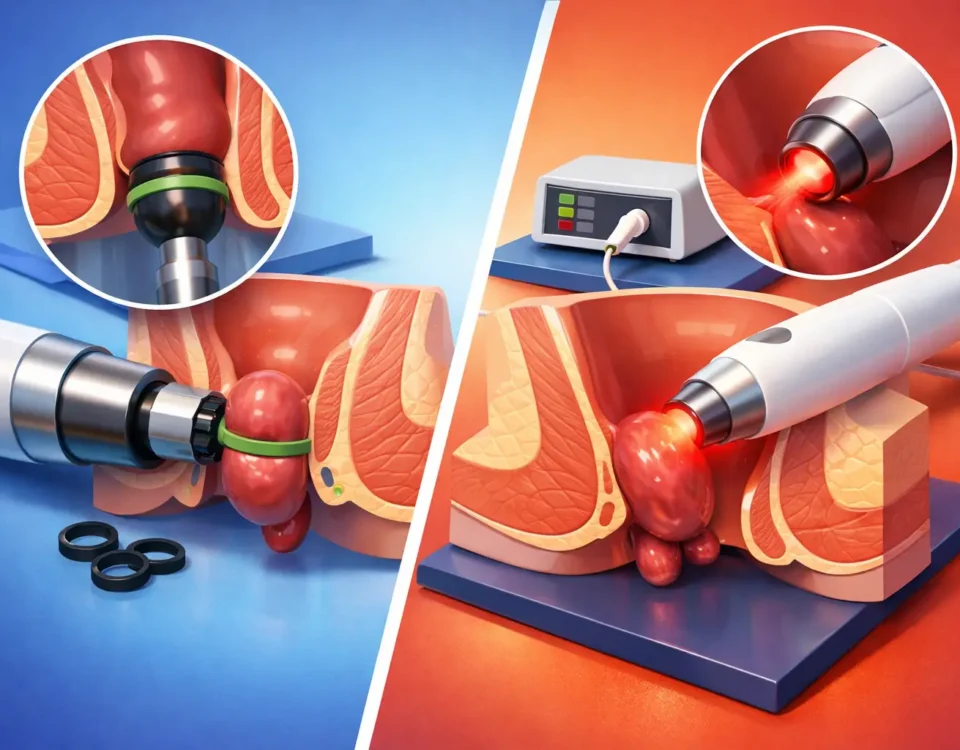
During banding, a provider places a very small band at the base of the internal hemorrhoid. This cuts off blood flow to the targeted tissue, which then shrinks and falls away over time. The procedure is performed in the office and typically takes only a few minutes.
For the right patient, banding offers several benefits. It is quick, does not involve surgical incisions, and usually allows a return to normal daily activity the same day. Many patients feel pressure rather than sharp pain because internal hemorrhoids are located in an area with fewer pain-sensitive nerves.
That said, banding is not the answer for every case. It is generally best suited for internal hemorrhoids, especially grade 1, grade 2, and some grade 3 hemorrhoids. If a patient has a large painful external hemorrhoid, a thrombosed hemorrhoid, or significant mixed disease, the plan may need to change.
Other office procedures may be used in select cases
Rubber band ligation is not the only office-based treatment, but it is often the most commonly recommended because of its track record. Other procedures can still have a role depending on the anatomy and symptom pattern.
Infrared coagulation uses heat to create scar tissue that reduces blood flow to the hemorrhoid. This can be useful for smaller internal hemorrhoids, particularly when bleeding is the main complaint. Recovery is usually straightforward, but some patients need multiple treatments, and it may not be as durable as banding for more advanced prolapse.
Sclerotherapy involves injecting a solution into the hemorrhoid to cause it to shrink. It can be considered for certain internal hemorrhoids and for patients who may not be ideal candidates for other techniques. The trade-off is that results can vary, and not every practice relies on it as a primary treatment.
In some situations, a provider may recommend medication-based treatment and symptom control rather than an immediate procedure. That is not a lesser approach. If inflammation is severe, if the diagnosis is uncertain, or if an anal fissure is driving the pain, treating the underlying issue first can lead to a better outcome.
Which hemorrhoids respond best to office treatment?
Internal hemorrhoids are usually the best candidates for office procedures. These are the hemorrhoids located inside the rectum that may cause bleeding, mucus, irritation, or tissue that protrudes during bowel movements.
Patients with grade 1 or grade 2 internal hemorrhoids often respond especially well. Some grade 3 hemorrhoids can also improve significantly with office treatment, although more than one session may be needed. If hemorrhoids are very large, persistently prolapsed, or associated with extensive external disease, the treatment discussion becomes more individualized.
External hemorrhoids are different. If the problem is primarily external swelling, a tender clot, or excess skin, office procedures designed for internal hemorrhoids may not solve the issue. This is where specialized evaluation matters. A patient may assume all hemorrhoids are the same, but the treatment strategy can change a lot based on that distinction.
What to expect during the visit
One reason patients delay care is the fear that treatment will be painful or embarrassing. In reality, an office hemorrhoid visit is usually more direct and manageable than people expect.
The appointment typically starts with a focused history of symptoms. Your provider will ask about bleeding, pain, prolapse, bowel habits, constipation, straining, prior treatment attempts, and how long symptoms have been going on. This helps determine whether hemorrhoids are likely and whether another condition should be considered.
The physical exam is brief but important. It may include inspection of the area and an internal exam to identify the source of symptoms. If an office procedure is appropriate, it may sometimes be performed during the same visit.
For banding, most patients describe the experience as uncomfortable pressure rather than severe pain. Afterward, there may be a sense of fullness or the urge to have a bowel movement for a short period. Mild soreness can occur, but many patients return to work and routine activity quickly.
Recovery is usually easier than patients expect
The biggest reason many adults look for office-based hemorrhoid treatment is simple: they do not want surgery if they can avoid it. For properly selected patients, office procedures can offer meaningful relief with much less downtime.
Recovery often includes a few practical instructions. Patients are usually advised to avoid straining, keep stools soft, stay hydrated, and use any prescribed medications as directed. Some providers also recommend fiber support or other bowel regimen changes to reduce the chance of recurrence.
Results are not always instant on day one. The treated hemorrhoid needs time to shrink, and symptoms often improve over several days to a few weeks depending on the procedure. If there are multiple hemorrhoids, treatment may be staged rather than done all at once.
This is one of the most important it-depends points. A fast procedure does not mean every case is one-and-done. Some patients improve after a single session, while others need follow-up treatment to get the best result.
Why specialization matters
Not every practice approaches hemorrhoids the same way. In a general setting, patients may be told to keep using creams, wait longer, or move toward surgery sooner than necessary. A specialized center is more likely to focus on the middle ground that many patients actually want: effective, office-based treatment that avoids major intervention when possible.
That focused experience matters because hemorrhoids and fissures can look similar from the patient perspective but require different care plans. A board-certified specialist who treats these conditions every day can usually identify the problem quickly and recommend a treatment pathway that fits the symptoms, anatomy, and recovery goals.
This is where providers such as Hemorrhoid Centers of America stand apart. The model is built around prompt evaluation, non-surgical procedures, and helping patients get back to normal life without a hospital-based experience.
When office procedures may not be the best choice
Office treatment is highly effective for many people, but not for every situation. If there is severe external disease, a large thrombosed hemorrhoid, another anorectal condition, or symptoms that suggest a different source of bleeding, the plan may need to be adjusted.
Some patients also wait until symptoms become advanced and constant. Even then, surgery is not automatic, but the range of options may narrow. The sooner a patient gets examined, the easier it is to match the problem with the least disruptive effective treatment.
If you have been relying on wipes, creams, baths, and avoiding certain chairs just to get through the day, that is usually a sign it is time for a real evaluation. The best office procedure for hemorrhoids is the one chosen after an accurate diagnosis, performed by an experienced specialist, and tailored to the symptoms that are actually making your life harder. Relief does not have to come with a hospital stay or a long recovery, and for many patients, it starts with one office visit.